
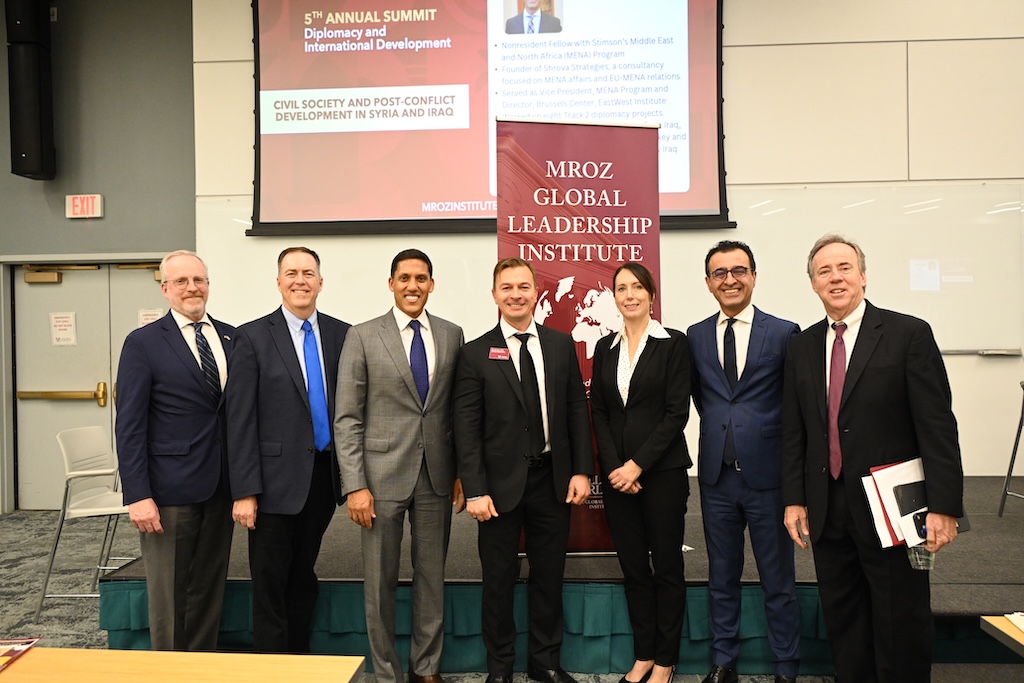
 Diplomacy Summits became a signature event organized by the Mroz Institute in the spring. The summits are highly anticipated by students, faculty, and community members because they give a unique opportunity to learn from and interact with global experts.
This year, we hosted the 5th Annual Summit focusing on Diplomacy and International Development. The summit was held in conjunction with the celebration of the 20th Anniversary of the School of Languages, Cultures, and World Affairs (LCWA) in partnership with the College of Charleston Libraries.
We brought together foreign policy and diplomacy practitioners to examine the intersection of security and development, soft power and foreign assistance, democracy and civil society, and the role of international development in advancing the US’s foreign policy. Our speakers were NGO leaders and career foreign service officers who have worked at the US Agency for International Development (USAID) and the US Department of State.
Dr. Rajiv Shah, the President of the Rockefeller Foundation, will give the keynote address. Dr. Shah has been committed to advancing the mission of USAID to end extreme global poverty and promote resilient, democratic societies, while advancing security and prosperity.
- Panel discussion on the state of international development – with David Kramer, Peter Natiello, Nancy Ostrowski, Greg Howell, Kawa Hassan. Facilitated by Max Kovalov.
The panel discussion focused on the current state of international development through the experiences of practitioners who have worked in democracy promotion, humanitarian assistance, public health, peacebuilding, and post-conflict reconstruction. Panelists reflected on their paths into the field, debated common misconceptions about foreign aid and development assistance, and considered the consequences of recent reductions in U.S. development funding. The conversation also explored the roles of governments, NGOs, and the private sector in supporting development, while addressing both the achievements of past efforts and the challenges that continue to shape the field.
Civil society and post-conflict development in Syria and Iraq – by Kawa Hassan, Nonresident Fellow with Stimson’s Middle East and North Africa Program.
Kawa Hassan discussed the role of civil society in post-conflict and authoritarian settings, particularly in Iraq and Syria. He argued that durable change often begins with local initiatives, from community discussion groups to medical centers serving vulnerable populations. Authoritarian regimes seek to weaken social trust and civic engagement, while civil society organizations help rebuild community ties, strengthen resilience, and create the foundations for long-term political and social change.
- Big Bets, keynote address by Dr. Rajiv Shah, President of the Rockefeller Foundation.
Dr. Rajiv Shah examined the future of international development at a time of growing uncertainty about global cooperation and foreign assistance. He used examples from his work during the Ebola response efforts, Haiti earthquake recovery, energy access initiatives, and vaccine production in Africa, and showed that evidence-based development programs deliver measurable results. Dr. Shah expressed concern about declining public support for foreign aid and suggested that development organizations must do a better job demonstrating results and explaining why international engagement serves both humanitarian goals and long-term US interests.
- Bringing Together Diplomacy, Development and Defense in Addressing Global Fragility – by Greg Howell, formerly Senior Deputy Assistant Administrator in USAID’s Bureau for Latin America and the Caribbean.
Greg Howell discussed the Global Fragility Act and its emphasis on conflict prevention as a tool of US foreign policy. Howells spent decades in the US Foreign Service and USAID and shared his insights from working in development in the Sahel region, Haiti, Niger, and Benin. He explained how coordinated efforts by USAID, State Department, and Department of Defense seek to strengthen local institutions, reduce violence, and promote long-term stability before crises emerge. The 3Ds – defense, diplomacy, and development – are essential to addressing the root causes of conflict, creating conditions for lasting peace and regional stability, and advancing US interests.
- The Case of the Colombian Peace Accords: A 3D Success? – by Peter Natiello, career diplomat with 35 years in the Foreign Service. He served as USAID’s Senior Humanitarian and Development Counselor.
Peter Natiello drew on his experience working in development in Colombia to explain how security, development, and diplomacy (3Ds) reinforced one another during Colombia’s peace process in the aftermath of the FARC armed conflict. He discussed reintegration programs, rural development, and efforts to weaken armed groups while strengthening state institutions.
- The Power of Private Sector Partnerships in Advancing 3D Goals in Africa – by Nancy Ostrowski, a former career diplomat who worked on national economic strategy, the intersection between security and development.
Nancy Ostrowski challenged the assumption that development is driven primarily by governments and aid agencies. In her view, long-term progress in Africa increasingly depends on attracting private investment to places where political instability, weak infrastructure, and environmental pressures discourage capital. Based on her development work on Djibouti’s water-access projects, she demonstrated how development programs can reduce risk, create commercial opportunities, and offer alternatives to state-directed Chinese investment.
- Democracy and Human Rights as Pillars of US Foreign Policy – by David Kramer, Executive Director of the George W. Bush Institute
David Kramer’s central question was why Americans should care about democracy abroad. His answer linked events in distant countries to everyday security concerns at home, from Russian cyberattacks targeting US hospitals to the broader effects of corruption and authoritarian influence. Rather than advocating intervention, he focused on helping citizens build independent institutions capable of holding governments accountable and protecting political freedoms. American security is linked to the expansion of freedom abroad.

Thursday, February 19, 2026
- 3:00pm-4:30pm. Session 1. Panel discussion on the state of international development – with David Kramer, Peter Natiello, Nancy Ostrowski, Greg Howell, and Kawa Hassan.
- 4:30pm-5:20pm. Session 2. Civil society and post-conflict development in Syria and Iraq – by Kawa Hassan. Kawa Hassa is a Nonresident Fellow with Stimson’s Middle East and North Africa Program.
- 6:00pm. Keynote address: Dr. Rajiv Shah, President of the Rockefeller Foundation.
Friday, February 20, 2026
- 9:00am-9:50. Session 3. Bringing Together Diplomacy, Development and Defense in Addressing Global Fragility – by Greg Howell. Greg Howell served as Senior Deputy Assistant Administrator in USAID’s Bureau for Latin America and the Caribbean.
- 10:00am-10:50am. Session 4. The Case of the Colombian Peace Accords: A 3D Success? – by Peter Natiello. Peter Natiello is a career diplomat with 35 years in the Foreign Service. He served as USAID’s Senior Humanitarian and Development Counselor.
- 11:00am-11:50am. Session 5. The Power of Private Sector Partnerships in Advancing 3D Goals in Africa – by Nancy Ostrowski. Nancy Ostrowski is a former career diplomat who worked on national economic strategy, the intersection between security and development
- 12:00pm (noon)-12:50pm. Session 6. Democracy and Human Rights as Pillars of US Foreign Policy – by David Kramer. David Kramer is the Executive Director of the George W. Bush Institute and is a leading expert on Russia and Ukraine.
Check out our previous programs. Recordings from previous summits are available on the Mroz Institute’s YouTube Channel.

